Coeliac Disease, Genetic Diversity and Different Needs
Published on 17/10/2012
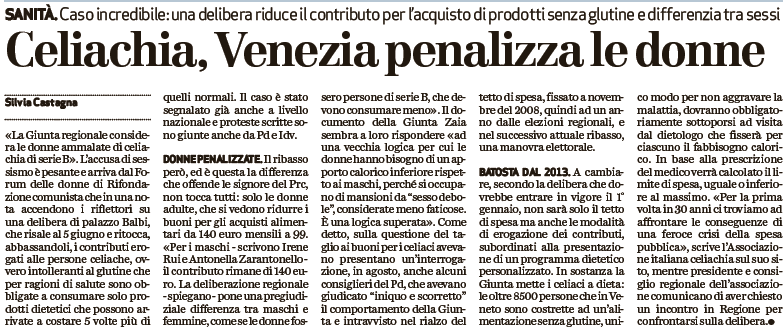
This is the response that the Nutricity Scientific Committee wished to give to the article that appeared in the Giornale di Vicenza last 7 October on the regional page, which accuses the Regional Administration of having committed a serious act of gender discrimination by differentiating the allowances for coeliacs between men and women.

The differences between men and women are well known and acknowledged, but let us explain them in detail in relation to the issue raised by the article.
The increase in lean (muscle) mass begins to differ between men and women from 12-13 years of age, and reaches 30% more in males. Indeed, testosterone increases bone and muscle mass in males, while oestrogens increase bone mass and fat in women. In other words, women have 37% less lean mass and 67% more fat mass relative to their own body weight. Muscle tissue is metabolically much more active than adipose tissue and almost single-handedly determines energy expenditure, and it is for this reason that men's requirements are greater than those of women. As proof of this, all the formulas for estimating energy requirements (validated with more refined techniques), for equal weight, height and age, give a different result for women and men.
Let us take the example of a subject aged 40, 170 cm tall and weighing 70 kg. If the subject is a man, the basal metabolic rate is 1609 KCal; if instead it were a woman, it is 1452 Kcal, about 10% less. The physical activity (work and sport) that is added to the basal requirement, metabolically activating the muscle mass, increases the difference in requirements between the sexes.
Now, in a healthy and balanced diet the energy share provided by carbohydrates should correspond to 50-60% of the daily energy requirement; among cereals, moreover, the gluten-free ones usually have a higher caloric content and lower amounts of Calcium and Fibre. There are foods such as rice, legumes, polenta, potatoes, milk and fruit that constitute excellent sources of carbohydrates and certainly are not lacking on the tables of the Veneto, representing in very many cases products at the base of the region's traditional diet.
The Veneto Region, at a time of economic constraint, has done nothing other than return to what was already provided for by the ministerial decree of 2006, seeking to introduce a balanced method of providing gluten-free products, which have high costs when compared with the equivalent products containing gluten.
Until now the allowance for the purchase of gluten-free foods has been managed independently by the patient without any particular forms of control.
The Region's provision puts in place a criterion to better modulate spending and to direct food consumption so as to bring it closer to the standards of a healthy diet. It was not an arbitrary criterion, but a clinical one and - although unused until now - it was chosen precisely in order to try to avoid gratuitous discrimination and to encourage the rediscovery of naturally gluten-free foods.
It can therefore reasonably be concluded that a difference in the caloric prescription as regards carbohydrate intake is - therefore - certainly a factor of difference between the sexes, but certainly not a factor of discrimination, because it respects the physiological differences between men and women.