North Korea: the bombs of the "starving"
Published on 8/4/2013
 There are common threads that seem to describe a given historical era better than others. If in the course of the nineteenth century it was the balance among the dominant European powers that culminated in colonial imperialism, and in the twentieth century the search for a balance of power in a "bipolar" world, today, in a context governed by international economic exchanges and strong demographic pressure, the world's attention is once again focused on the control of energy resources, and on food in particular as the primary energy source for the planet's own inhabitants.
What strategic thinking correctly defines as Food Security, that is, control of the resources needed to satisfy the world's food requirements, has exploded in recent years, highlighting all the difficulties of finding a balance between supply and demand, both at the global level and at the local level of individual states, for reasons rooted in reckless political choices, in the forced application of failed economic-productive models, or in the failure to control the balance among productive factors, in defiance of the most elementary Malthusian rules.
Today we have before our eyes the sad story of North Korea, one of the last "orthodox" communist regimes, an enemy of the free market and of international trade, which at the collapse of the USSR and COMECON (of which it was, incidentally, never a member) found itself wrong-footed and deprived of the economic means for its own sustenance.
When the power of Moscow and the Politburo faded, Korea found itself without protection and without money, since the little left in the coffers of the "brother countries of Moscow" had been claimed back by Gorbachev as reimbursement for long years of aid, in a desperate attempt to repair the Soviet Union's financial collapse.
Without money and without aid, Pyongyang withstood the blow thanks to the providential intervention of China, which guaranteed coverage of over 70% of Korea's food needs. Alongside China, North Korea maintained good relations with Laos and Vietnam, countries incapable of bearing the burden of economic aid to a nation in a production crisis.
In 1993, a collapse in Chinese grain production and an initial across-the-board rise in costs forced Beijing to tighten the rope on Korea. This year therefore marks the twentieth anniversary of what is remembered as the "Arduous March", which marked the beginning of the "Korean Famine", between 1994 and 1998.
The earth is a merciless mother, and in those same years tropical monsoon rains swept away over 1 million tonnes of grain production, triggering a spiral of famine and malnutrition that cost the lives of an unspecified number of people, estimated at between 500,000 and 1.5 million.
Pyongyang has never recovered from those tragic years, remaining largely dependent on international aid coming overwhelmingly from China and South Korea and, to a lesser extent, from the United States and the UN through the World Food Program.
In these same years, food supplies have become the instrument for negotiating parallel agreements, tied to policies for containing nuclear proliferation and to respect for the truce signed between the two Koreas back in 1953 to establish their mutual border along the 38th parallel.
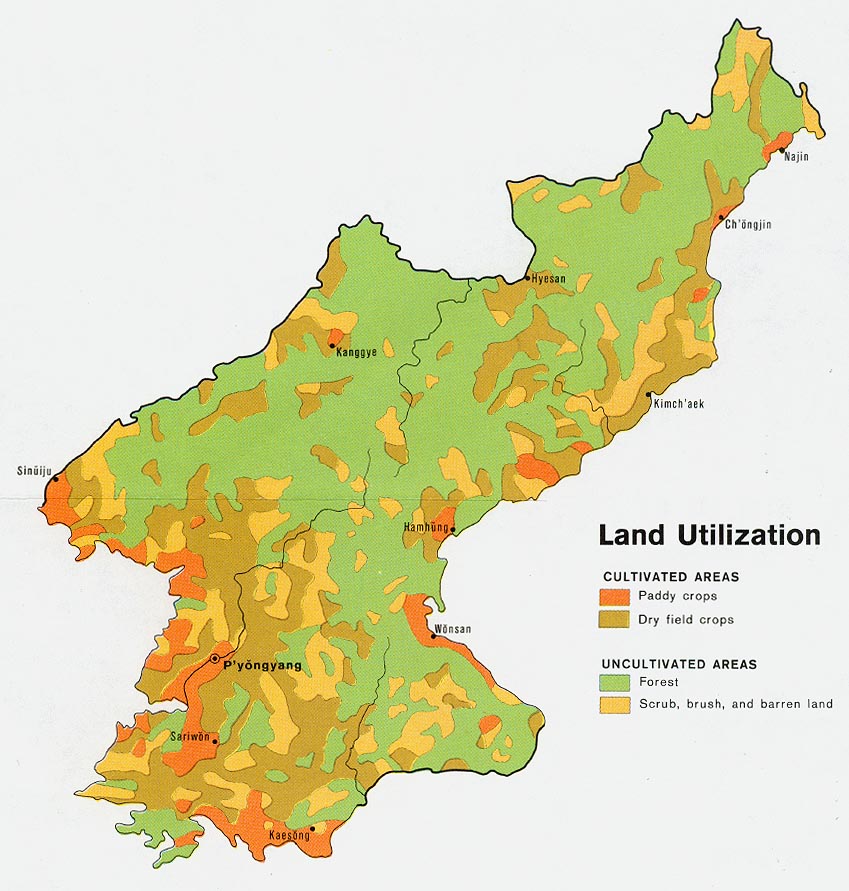 image from www.mappery.com[/caption]
 The nepotistic dictatorial regime of the Kim family (grandfather, father, and today grandson) has not been able to launch a reconstruction and reconversion of the national infrastructure and production system, which remains regimented in the Soviet-style collectivist form and deficient in infrastructure, with a resulting average decline in productivity recorded over the last 30 years, particularly striking in the agri-food sector, whose effects are even more serious and conspicuous for a country that cultivates less than 20% of its total land area.
Austerity policies and largely misguided public health and hygiene measures (rationing of food consumption with a cap of 2 meals per day), together with the express determination not to change anything in the agri-food production system, have exposed the country to repeated production crises: notable among these is the one in 2007, which drew the attention of the world press and the UN -which warned of a risk of malnutrition for over a quarter of the population (6 million people)- and more recently in 2011, to which the EU responded by sending food supplies worth around 10 million euros.
A concise but dense report released by the news agency Asia Press last January paints a desperate picture of North Korea, highlighting a socially terrifying and alarming finding picked up by numerous newspapers around the world: the explosion of episodes of cannibalism involving in particular some peripheral provinces in the southernmost portion of the country. It would, however, be more accurate to speak of anthropophagy driven by hunger/famine, since by the term cannibalism we commonly mean a social and cultural custom inherited by certain populations living in contexts of total isolation from modernity (Papua New Guinea, South America) and tied to tribal religious factors.
The causes of this monstrous social custom are to be traced back to the distortions of the collectivist agricultural policy, which requires producers to meet national production quotas, which are then appropriated by the State in the quantity needed to cover the estimated requirements of its own apparatus, leaving the surplus to producers as compensation for production.
The climatic adversities of the 1990s then left producers high and dry, without means, machinery or fuel. The result was a drop in production poorly estimated by the central government, without the collective levy quotas being revised accordingly.
The army was deployed to collect its own share of agricultural production -"food for the army"- forcing farmers to borrow money (with interest) from the equivalent of our (public) agricultural consortia to buy seeds, fertilizers and pesticides, in a desperate attempt to increase production.
In the spiral of this static system, characterized by high levels of corruption and feudal practices worthy of tax farmers, Korea's rural population has been reduced to hunger and to the impossibility of launching a productive revolution, crushed under the weight of its own debts.
Very few cases comparable to the phenomenon we are pitilessly witnessing in North Korea come to mind.
Of these, most belong to remote historical eras or are in any case so distant in social and cultural conditions as to be incomparable (see the cases of China in 1200 and Egypt during the famine of 1201), while we can tragically draw a parallel with an episode that has remained in the shadows of history, which occurred in the Soviet Socialist Republic of Ukraine between 1932 and 1933, remembered as the Holodomor (Ukrainian for "extermination by hunger"), in which an unspecified number of people, estimated at between 1.5 and 3 million, are believed to have lost their lives.
Forced collectivization, introduced by law without a pilot phase of adjustment, led to rebellions, constant under-production and the spread of episodes of cannibalism, branded by the Soviet regime as cases of savage madness for which the Cossacks were blamed first and foremost.
What the Democratic People's Republic of North Korea is experiencing today risks being something more than a simple resurgence of the famine already known in the 1990s, proving even worse than what happened twenty years ago, owing to the interweaving of agronomic and medical factors.
On the one hand, the impoverishment of the soil resulting from misguided agronomic practices, the fruit of the financial collapse that followed the economic-productive crisis of the 1990s; on the other, the medical-genetic risk arising from prolonged malnutrition that has lasted for twenty years, culminating in the very recent episodes of anthropophagy that go as far as the trade in human flesh on the black market.
The consumption of human flesh is, moreover, associated with various neurological diseases, which have led the civil authorities of all States to ban cannibalism even where it persists as a ritual practice with religious significance.
This is the case of the Fore (tremor) tribe of Papua New Guinea, among whom a study conducted in 1957 by Nobel laureate D. C. Gajdusek revealed a wide prevalence of diseases with neurological symptoms (ataxia, tremors and disturbances of consciousness) that proved fatal roughly 3 to 9 months after onset. This disease, known locally as Kuru (the laughing death, owing to the facial paresis that is one of its most conspicuous symptoms), belongs to the family of spongiform encephalopathies, which cause a mutation of brain tissue, making it spongy and riddled with holes.
The cause of these pathological forms turned out to be an "infectious protein" known as a prion. A prion is a protein that has folded incorrectly and is then able to infect adjacent proteins. The phenomenon follows a rather rapid and exponential course, so the mass of misfolded proteins destroys cell functionality and causes cell death.
The same happens in what is known as mad cow disease (bovine spongiform encephalopathy), which over the last 15 years has shaken the European market for beef. Originating from the British practice of feeding cattle with meal of animal origin, the disease was transmitted to humans, triggering a collective psychosis that lasted about a decade (1996-2006).
Fortunately, the national authorities of several European countries, together with EU bodies (EFSA), promptly adapted the regulatory system and the food safety protocols, substantially reducing the risk of transmission of the infection.
While, on the one hand, those genes -mutant versions of the prion- that would appear to protect against "prion" diseases are widespread in every population in the world, deriving from a natural selection of the human species (genetic polymorphism) that began with prehistoric populations among whom cannibalism was a widespread custom, on the other hand, medical science is unable to halt the infection once it has been contracted, with an almost always fatal outcome for the infected individual.
According to the local gastronomic tradition, the diet of a North Korean appears relatively balanced: rich in fiber thanks to the large consumption of vegetables and legumes found in some of the most popular dishes of the country's culinary culture (“kimchi” made from cabbage, onions, turnips and various seasonal vegetables, seasoned with generous doses of pepper and garlic and left to ferment for weeks). In the typical Korean diet, tradition also calls for a measured consumption of meat, found in various dishes such as "Sinsollo" and "Pulgogi": the first a meat and vegetable broth enriched with nuts and eggs, the second slices of beef marinated and grilled over charcoal.
Some gastronomic customs, however, depart considerably from Western dietary patterns and involve a large consumption of insects (silkworms, roasted red ants and cockroaches) together with dog meat and snakes, while milk and dairy products are entirely absent.
 In this way we can make some suppositions to better understand -even in the absence of statistical data- how the persistent economic-productive crisis of the last 20 years has affected and modified the diet of North Koreans: cattle farms have presumably all but disappeared, given the impossibility of feeding livestock, while an increase in the consumption of dog meat, if not actually human flesh, will have been recorded -as the Asia Press report indicates with regard to a trade in human flesh for food use. The consumption of vegetables will also have undergone a drastic downsizing following the disappearance of the large collective farms, destroyed and never rebuilt after the cataclysms of the 1990s and 2007, to which the regime responded by tightening the forced levy on the production quotas of small farmers. It is conceivable that the traditional consumption of insects has expanded in a desperate attempt to compensate, as far as possible, for the drop in protein and vitamin intake resulting from the reduced use of meat and vegetables.
The UN already in 2011 went so far as to define the Korean food crisis "one of the most underfunded chronic humanitarian emergencies in the world", while at the same time recording a widespread practice of embezzlement of international aid, which over the years has ended up financing the country's "nuclear rearmament" program that today worries chancelleries across half the world. The military option appears to be madness for a country now devoid of allies (the alliance with China is almost purely formal and of little interest to the Asian giant), absolutely not self-sufficient in any productive respect, with only 20% of its land arable and a population exhausted by over 20 years of political and economic isolation.